


[Sep-2026] CSQE Dumps PDF - CSQE Real Exam Questions Answers
CSQE Dumps 100% Pass Guarantee With Latest Demo
NEW QUESTION # 133
A software quality engineer (SQE > is testing software in a system used to monitor critically ill patients and administer dosages of life-sustaining medicines Tests reveal a flaw that could result in an unscheduled shutdown under certain circumstances. Ox er the SQE ' s verbal and written objections: the director of engineering decides to ship the system. The SQE knows from experience that " whistle-blowers " in the company have lost their jobs The most appropriate next step for the SQE would be to
- A. discuss with top management
- B. inform the customer
- C. remain silent
- D. gam support from workers
Answer: A
Explanation:
In a situation where a software quality engineer (SQE) identifies a critical flaw and the immediate superior decides to proceed despite the risk, the most appropriate next step is to discuss the issue with top management. This involves:
* Documenting the Issue : Clearly outlining the flaw, its potential impact, and the SQE ' s objections.
* Escalating the Concern : Bringing the issue to the attention of higher management levels who have the authority to reconsider the decision.
* Focusing on Safety : Emphasizing the critical nature of the flaw, especially in a system used for monitoring critically ill patients.
This step ensures that the concerns are heard at the highest level, potentially preventing a decision that could endanger lives and the company ' s reputation.
References:
" Software Quality Assurance: Principles and Practice " by Nina S. Godbole IEEE Code of Ethics
NEW QUESTION # 134
Which of the following describes when a test plan should be changed?
- A. After changes to the design specifications
- B. After each code review
- C. When the configuration management tool is updated
- D. After product stability has been assessed
Answer: A
Explanation:
A test plan should be changed after changes to the design specifications. This ensures that the tests remain relevant and accurately reflect the new design and functionality of the software. Keeping the test plan updated with design changes helps ensure comprehensive test coverage and alignment with the project's requirements.
NEW QUESTION # 135
Which of the following metrics would be most appropriate for evaluating how effective the peer review process was for removing defects?
- A. Requirements volatility
- B. Defect density
- C. First-pass yield
- D. Cycle time
Answer: B
Explanation:
Defect density is a metric that measures the number of defects relative to the size of the software component (e.g., per thousand lines of code). It is particularly useful for evaluating the effectiveness of the peer review process in removing defects. By calculating defect density before and after the peer review process, teams can assess how many defects were identified and addressed during reviews. This metric helps in understanding the quality of the code and the effectiveness of the review process in identifying and mitigating defects. Higher effectiveness in peer reviews typically results in lower defect density. Industry practices and standards, such as those from IEEE or ISO, often recommend using defect density as a key quality metric.
NEW QUESTION # 136
A project team conducts a review of its latest software design The review process is well-defined and is used by all projects within the company. As part of the review process, defect levels are compared against acceptable limits to determine appropriate corrective action. According to the CMMI-DEV Vl_2_. which of the following activities could the company perform to demonstrate characteristics unique to a Maturin ' Level
5 organization?
- A. Submit defect data to a team for future defect prevention.
- B. Assess the validity of each defect data measurement independently.
- C. Record defect data and establish the process capability baseline
- D. Collect defect data for each project ' s specific software process.
Answer: A
Explanation:
A Maturity Level 5 organization, according to the Capability Maturity Model Integration for Development (CMMI-DEV) V1.2, is focused on continuous process improvement. Such organizations leverage quantitative data to prevent defects and optimize processes. Submitting defect data to a team dedicated to future defect prevention aligns with this objective, as it emphasizes proactive measures to improve quality and prevent issues from reoccurring.
Collecting defect data and establishing process capability baselines are characteristics of lower maturity levels, while independent assessment of defect data ensures accuracy but does not inherently demonstrate a Level 5 focus on continuous improvement.
References:
CMMI for Development, Version 1.2, Carnegie Mellon University.
" CMMI: Guidelines for Process Integration and Product Improvement " by Mary Beth Chrissis, Mike Konrad, and Sandy Shrum.
NEW QUESTION # 137
Once a problem has been identified in the problem resolution process, which of the following steps should be taken next?
- A. Determine probable causes
- B. Take corrective action
- C. Seek authority to act
- D. Search for solutions
Answer: A
Explanation:
After a problem is identified, the next logical step is to determine its probable causes. Software quality engineering emphasizes cause-based problem resolution rather than simply treating symptoms. If the team jumps directly to solutions or corrective action, it may fix the visible failure while leaving the true process, design, coding, testing, or requirements issue unresolved. Determining probable causes may involve root cause analysis, cause-and-effect diagrams, defect classification, data review, interviews, or process investigation. Once likely causes are understood, solutions can be evaluated and corrective actions can be selected. Seeking authority may be needed later depending on the corrective action, but it is not the immediate analytical step. Therefore, probable cause determination comes next.
NEW QUESTION # 138
Which of the following verification and validation techniques is used to verify that the completed requirements and designs conform to their requirements specifications?
- A. Feasibility analysis
- B. Functional configuration audits
- C. Execution of test cases
- D. Mathematical proofs of correctness
Answer: B
Explanation:
Functional configuration audits are used to verify that the completed requirements and designs conform to their requirements specifications. These audits involve checking that the developed product meets all the specified requirements and that the design has been implemented correctly. This process ensures that the final product aligns with the original requirements and design specifications, maintaining consistency and quality.References:
* IEEE Std 828-2012, IEEE Standard for Configuration Management in Systems and Software Engineering.
* ISO/IEC/IEEE 29148:2011, Systems and software engineering - Life cycle processes - Requirements engineering.
NEW QUESTION # 139
A software engineer collected the following data set during testing
12, 13, 13, 15, 18, 14, 16, 15, 12, 18, 17, 16, 16, 15, 14
The engineer then used the following class intervals to represent the data in a histogram
11.5-13.5
13.5-15.5
15.5-17.5
17.5-19.5
Which of the following statements describes these class intervals most accurately?
- A. They should be whole numbers since the data are whole numbers
- B. They are unrelated to the data set
- C. They are appropriate.
- D. They fail to describe the full range of data
Answer: C
Explanation:
The class intervals 11.5-13.5, 13.5-15.5, 15.5-17.5, and 17.5-19.5 are appropriate for representing the given data set in a histogram. These intervals cover the entire range of the data, ensuring each data point falls within a specific interval, and they are consistent in width, which is crucial for accurate histogram representation.
Reference: Statistical analysis and data representation guidelines which recommend using class intervals that encompass all data points and maintain equal widths.
NEW QUESTION # 140
If N equals the number of defects originating and found in phase X, and S equals the number of defects originating in phase X and found in subsequent phases, which of the following represents the efficiency rate of error detection for phase X?
- A. (N + S) / N
- B. N × S
- C. N / (N + S)
- D. N / (N # S)
Answer: C
Explanation:
The efficiency rate of error detection for a phase measures how effectively that phase detects defects that originated in the same phase before they escape to later phases. N represents defects both originated and found in phase X. S represents defects that originated in phase X but escaped and were found in later phases.
Therefore, the total number of defects originating in phase X is N + S. The detection efficiency for phase X is the portion found within the phase, which is N divided by N + S. Option A reverses the relationship and can produce a value greater than one. Option C is not a rate. Option D is not a valid defect containment formula.
The correct formula is N / (N + S).
NEW QUESTION # 141
Which of the following activities is classified as data collection and storage?
- A. Supporting data technology usage and related issues
- B. Installing and administering data technology
- C. Confirming adequacy, uniqueness, and consistency of data
- D. Providing mechanisms that support data availability requirements
Answer: C
Explanation:
Data collection and storage activities are focused on ensuring that the data is adequate, unique, and consistent.
This involves:
* Adequacy: Ensuring that the collected data meets the necessary requirements for its intended use.
* Uniqueness: Verifying that the data is not duplicated and is uniquely identifiable.
* Consistency: Ensuring that the data is consistent across different datasets and over time.
These activities are critical for maintaining the integrity and reliability of the data, which is essential for effective data analysis and decision-making.
References:
* "Data Quality: The Accuracy Dimension" by Jack E. Olson
* "Data Management for Researchers" by Kristin Briney
NEW QUESTION # 142
The use of a rigorous mathematical proof to analyze the algorithm of a software component is a feature of
- A. formal methods
- B. functional decomposition
- C. dynamic analysis
- D. boundary value analysis
Answer: A
Explanation:
Formal methods involve the use of rigorous mathematical proofs to analyze and verify the correctness of algorithms within a software component. This approach provides a high level of assurance in the reliability and correctness of the software by mathematically proving properties of the algorithm or system. Unlike boundary value analysis, functional decomposition, or dynamic analysis, formal methods use mathematical models to verify system behaviors and correctness without executing the system.
NEW QUESTION # 143
When a software change order is reviewed by the change control board (CCB), it is assigned a status from which of the following sets of classifications?
- A. Escalated, rejected, in progress
- B. Escalated, proposed, accepted
- C. Accepted, evaluated, m progress
- D. Approved, disapproved, deferred
Answer: D
Explanation:
When a software change order is reviewed by the Change Control Board (CCB), it undergoes a formal assessment to determine the impact and feasibility of the change. The CCB typically assigns one of the following statuses:
* Approved: The change is accepted and will be implemented.
* Disapproved: The change is rejected and will not be implemented.
* Deferred: The decision on the change is postponed, often pending further information or consideration.
These classifications help in managing changes systematically, ensuring only feasible and beneficial changes are made to the software system.
References:
* IEEE Standard for Configuration Management in Systems and Software Engineering (IEEE Std
828-2012)
* Software Engineering Body of Knowledge (SWEBOK)
NEW QUESTION # 144
Which of the following techniques would be most appropriate for identifying the source of a problem?
- A. Interrelationship digraph
- B. Affinity diagram
- C. Root cause analysis
- D. Prioritization matrix
Answer: C
Explanation:
Root cause analysis (RCA) is a systematic process used to identify the underlying causes of a problem. It is the most appropriate technique for identifying the source of a problem due to the following reasons:
* Problem Identification : RCA focuses on identifying the fundamental issues that lead to a problem, rather than just addressing the symptoms.
* Systematic Approach : It involves a structured methodology to investigate and analyze the problem, ensuring that all potential causes are considered.
* Effective Solutions : By understanding the root causes, organizations can implement effective and long- lasting solutions to prevent recurrence.
Reference: " Root Cause Analysis: A Tool for Total Quality Management: Root cause analysis is essential for identifying and addressing the underlying causes of problems, leading to more effective solutions. " (Total Quality Management Journal)
NEW QUESTION # 145
Which of the following individuals on the Change Control Board (CCB) is responsible for escalating change requests and other issues to a higher level CCB or management?
- A. Scribe
- B. Screener
- C. Member
- D. Chair
Answer: D
Explanation:
The Chair of the Change Control Board (CCB) is responsible for escalating change requests and other issues to a higher level CCB or management. The Chair ensures that all changes are properly reviewed and approved, and any significant issues that cannot be resolved at the current level are escalated for further consideration.
Reference: ITIL (Information Technology Infrastructure Library) Change Management guidelines, which describe the roles and responsibilities within the Change Control Board, including the escalation process led by the Chair.
NEW QUESTION # 146
The following chart was created by a team.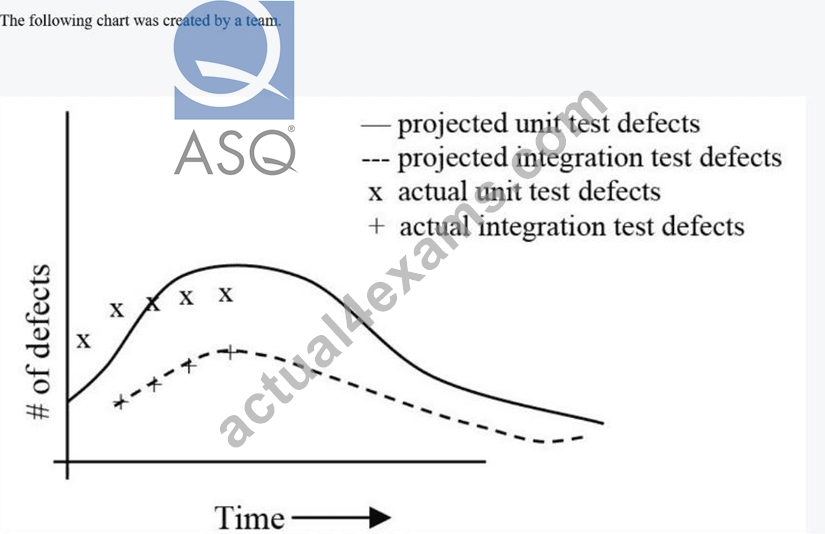
The chart shows number of defects over time, including projected unit test defects, projected integration test defects, actual unit test defects, and actual integration test defects. Which of the following conclusions can be drawn from this chart?
- A. Unit testing is isolating as many defects as predicted.
- B. Unit testing has been poorly planned.
- C. Integration testing is isolating as many defects as predicted.
- D. Integration testing is very effective in isolating defects.
Answer: C
Explanation:
The chart compares projected defect discovery patterns with actual defect discovery patterns for unit testing and integration testing. The actual integration test defects, shown by the plus markers, closely follow the projected integration test defect curve. This indicates that integration testing is finding approximately the number of defects expected over time. The unit test actuals do not provide as strong a match to the projected unit test curve, so concluding that unit testing is isolating exactly as predicted is less supported. The chart also does not prove poor unit test planning or unusually high integration test effectiveness; it simply compares actual results to predictions. Therefore, the supported conclusion is that integration testing is isolating as many defects as predicted.
NEW QUESTION # 147
Which of the following best defines the total cost of quality for a software project?
- A. Quality assurance and testing budgets
- B. Planning, designing, and testing
- C. Fixing defects and maintenance
- D. Prevention, appraisal, and failures
Answer: D
Explanation:
The total cost of quality includes all costs associated with achieving quality and all costs caused by poor quality. In software quality engineering, these costs are commonly grouped into prevention costs, appraisal costs, internal failure costs, and external failure costs. Prevention costs include activities such as training, process improvement, standards, and defect prevention. Appraisal costs include reviews, audits, inspections, and testing used to evaluate conformance. Failure costs include rework, defect correction, retesting, support, warranty, customer dissatisfaction, and post-release failures. Quality assurance and testing budgets represent only part of the total. Fixing defects and maintenance describe failure-related costs but exclude prevention and appraisal. Planning, designing, and testing are development activities, not the full cost of quality.
NEW QUESTION # 148
A software quality engineer (SQE > is testing software in a system used to monitor critically ill patients and administer dosages of life-sustaining medicines Tests reveal a flaw that could result in an unscheduled shutdown under certain circumstances. Ox er the SQE's verbal and written objections: the director of engineering decides to ship the system. The SQE knows from experience that "whistle-blowers" in the company have lost their jobs The most appropriate next step for the SQE would be to
- A. discuss with top management
- B. inform the customer
- C. remain silent
- D. gam support from workers
Answer: A
Explanation:
In a situation where a software quality engineer (SQE) identifies a critical flaw and the immediate superior decides to proceed despite the risk, the most appropriate next step is to discuss the issue with top management.
This involves:
* Documenting the Issue: Clearly outlining the flaw, its potential impact, and the SQE's objections.
* Escalating the Concern: Bringing the issue to the attention of higher management levels who have the authority to reconsider the decision.
* Focusing on Safety: Emphasizing the critical nature of the flaw, especially in a system used for monitoring critically ill patients.
This step ensures that the concerns are heard at the highest level, potentially preventing a decision that could endanger lives and the company's reputation.
References:
* "Software Quality Assurance: Principles and Practice" by Nina S. Godbole
* IEEE Code of Ethics
NEW QUESTION # 149
A project leader realizes that a deadline for a complete system build cannot be met because of staffing constraints. Which of the following actions should the leader take at this point to manage the project successfully?
- A. Assume a best-case scenario and revise the project management plan to match
- B. Reduce testing time for the project
- C. Revise the validation testing schedule to run parallel with the development phase
- D. Use an incremental implementation strategy
Answer: D
Explanation:
When staffing constraints make a complete system build unrealistic by the deadline, the project leader should manage scope and delivery risk rather than compromise quality. An incremental implementation strategy allows the team to deliver the system in smaller, prioritized parts. This supports earlier integration, earlier feedback, better risk control, and more realistic scheduling. Running validation testing in parallel with incomplete development may create invalid results if the product is not ready. Reducing testing time increases the risk of releasing defects and weakens quality assurance. Assuming a best-case scenario is poor project management because it ignores known constraints. Incremental delivery is the most practical approach because it adapts the plan while preserving quality and stakeholder value.
NEW QUESTION # 150
Which of the following can be used to assess the impact of a proposed software change?
- A. Regression testing
- B. Baseline audit
- C. Traceability matrix
- D. Defect rate
Answer: C
Explanation:
A traceability matrix can be used to assess the impact of a proposed software change. This tool maps requirements to their corresponding test cases, ensuring that all requirements are covered and helping to identify the effects of changes on existing functionality. By providing a clear link between requirements, development, and testing, a traceability matrix facilitates impact analysis and helps in maintaining the integrity of the system during changes.
References:
* "Software Requirements Traceability" by Anne Mette Jonsson and Jorgen Holm Westergaard
* "Managing Software Requirements: A Unified Approach" by Dean Leffingwell and Don Widrig
NEW QUESTION # 151
One of the biggest challenges in software testing is knowing
- A. which functions to test
- B. when to start testing
- C. when to stop testing
- D. which tests to use
Answer: C
Explanation:
Knowing when to stop testing is one of the biggest challenges in software testing. This challenge stems from the fact that exhaustive testing is practically impossible due to constraints of time and resources. Testers must decide when enough testing has been done to ensure an acceptable level of quality and risk. This decision is often based on various factors such as coverage of requirements, defect discovery rates, risk assessments, and project timelines.
References:
* "Software Testing: A Craftsman's Approach" by Paul C. Jorgensen.
* ISTQB Foundation Level Syllabus.
NEW QUESTION # 152
Which of the following disadvantages are associated with the "formal meeting" technique of oral communication?
- A. Can degrade into time wasters, some people feel uncomfortable offering opinions in public, and difficult for remote team members
- B. Loss of non-verbal communication, no permanent record, and time consuming
- C. Can degrade into time wasters, can be disruptive, and requires considerable planning and skills to achieve positive impression
- D. Loss of non-verbal communication, one way communication, and all topics may not be relevant to all team members
Answer: A
Explanation:
Formal meetings, while useful, can have several disadvantages:
* They can degrade into time wasters if not well-managed.
* Some people might feel uncomfortable offering opinions in a public setting, leading to a lack of valuable input.
* It can be challenging for remote team members to participate effectively, especially if the meeting relies heavily on in-person dynamics.
References:
* "Peopleware: Productive Projects and Teams" by Tom DeMarco and Timothy Lister
* "The Art of Project Management" by Scott Berkun
NEW QUESTION # 153
Entry and exit criteria for product development should be used to determine
- A. compliance with the specified development lifecycle
- B. whether schedule, budget, and resource requirements are being met
- C. when configurable items should be placed under library control
- D. when one phase is complete and the next phase can begin
Answer: D
Explanation:
Entry and exit criteria define the conditions required to start and complete a development phase. In software quality engineering, these criteria help ensure that work products are sufficiently complete, reviewed, tested, approved, and controlled before the project moves forward. Exit criteria may include completed reviews, resolved critical defects, approved deliverables, updated traceability, and successful testing. Entry criteria for the next phase confirm that the required inputs are available and acceptable. These criteria support lifecycle discipline and reduce the risk of carrying unresolved defects or incomplete work into later stages. While they may indirectly support compliance and schedule control, their direct purpose is to determine whether one phase is complete and the next phase can begin.
NEW QUESTION # 154
Which of the following actions is designed to prevent future defects?
- A. Using white-box testing
- B. Applying reverse-engineering to a defective system
- C. Conducting a causal analysis
- D. Injecting defects to test a system
Answer: C
Explanation:
Causal analysis is a process used to identify the root causes of defects so that these causes can be addressed to prevent future defects.
* Identification of Root Causes: Causal analysis involves techniques like root cause analysis (RCA) to systematically identify the underlying reasons for defects.
* Preventive Actions: Once the root causes are identified, preventive actions can be designed and implemented to mitigate these causes, thereby reducing the likelihood of similar defects occurring in the future.
* Continuous Improvement: Conducting regular causal analysis sessions contributes to continuous improvement in the development process, helping the team learn from past mistakes and enhance their practices.
NEW QUESTION # 155
Coverage monitors are used during which of the following types of testing?
- A. Equivalence partitioning
- B. White-box
- C. Black-box
- D. Stress
Answer: B
Explanation:
Coverage monitors are tools used to measure the extent to which the source code of a program is executed when a particular test suite runs. This is a key aspect of white-box testing, which involves testing the internal structures or workings of an application, as opposed to its functionality (which is the focus of black-box testing).
Coverage monitoring helps in identifying parts of the code that are not executed by a set of test cases, ensuring thorough testing and identifying untested paths.
:
" Software Testing: Principles and Practices " by Naresh Chauhan
" Software Testing Techniques " by Boris Beizer
NEW QUESTION # 156
Which of the following tools should be used to identify the steps in the development process that are the source of the most software defects?
- A. Pareto chart
- B. Control chart
- C. Scatter diagram
- D. Run chart
Answer: A
Explanation:
A Pareto chart should be used to identify the steps in the development process that are the source of the most software defects. The Pareto chart is a bar graph that identifies the most significant factors in a dataset and is based on the Pareto principle (80/20 rule), which suggests that 80% of problems are often due to 20% of the causes. This tool helps in pinpointing the primary sources of defects so that improvement efforts can be focused effectively.
References:
* Juran, J. M., & Godfrey, A. B. (1999). Juran's Quality Handbook (5th Edition).
* Montgomery, D. C. (2009). Introduction to Statistical Quality Control (6th Edition).
NEW QUESTION # 157
......
Dumps Real ASQ CSQE Exam Questions [Updated 2026]: https://preptorrent.actual4exams.com/CSQE-real-braindumps.html